
Free Printable Shooting Targets, True Scale
The Target Shed: US Letter and A4, every sheet drawn 1:1.
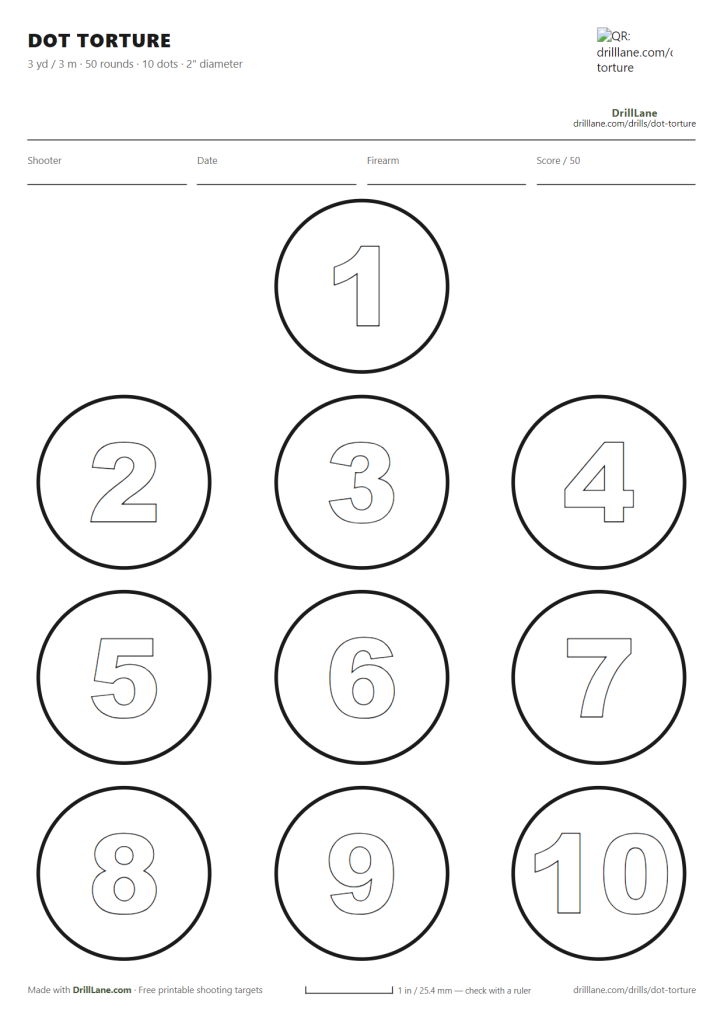
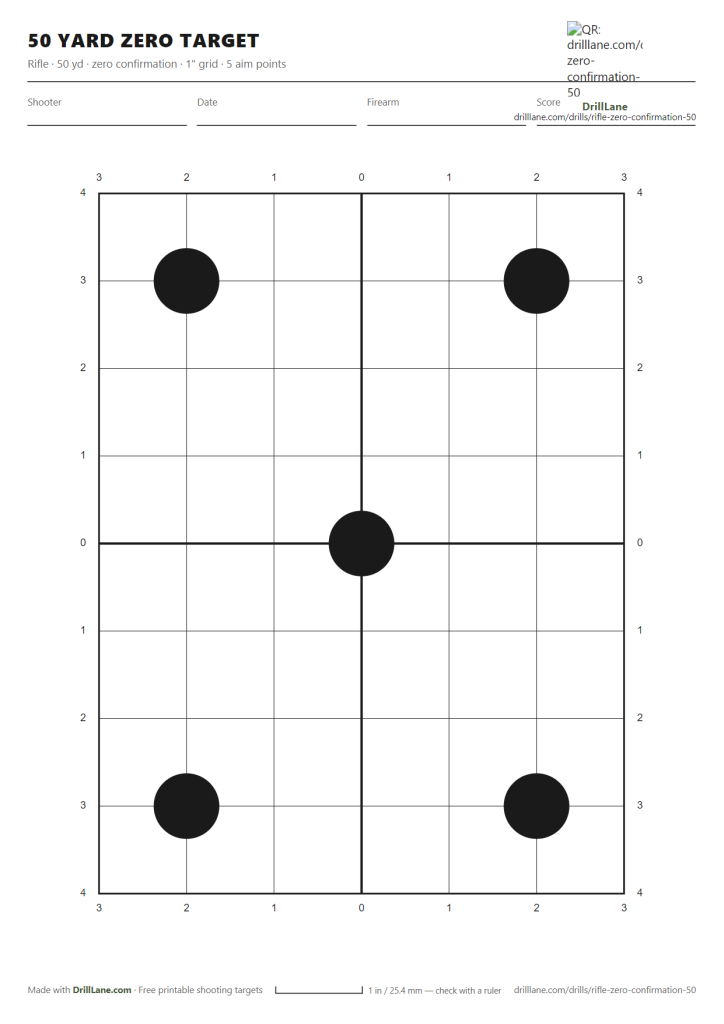


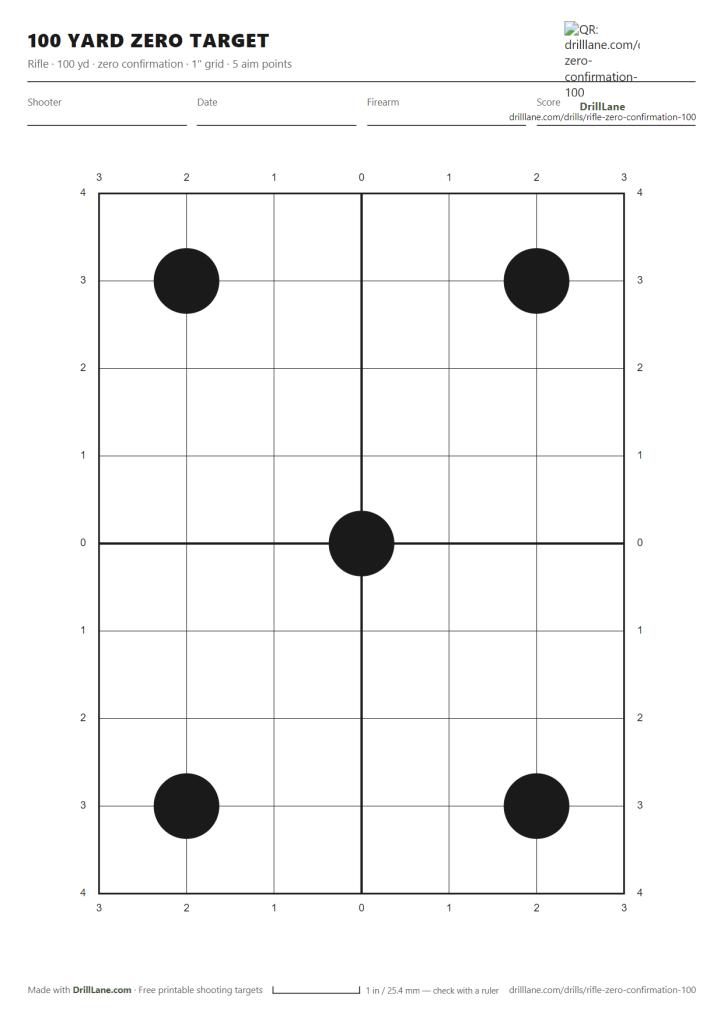
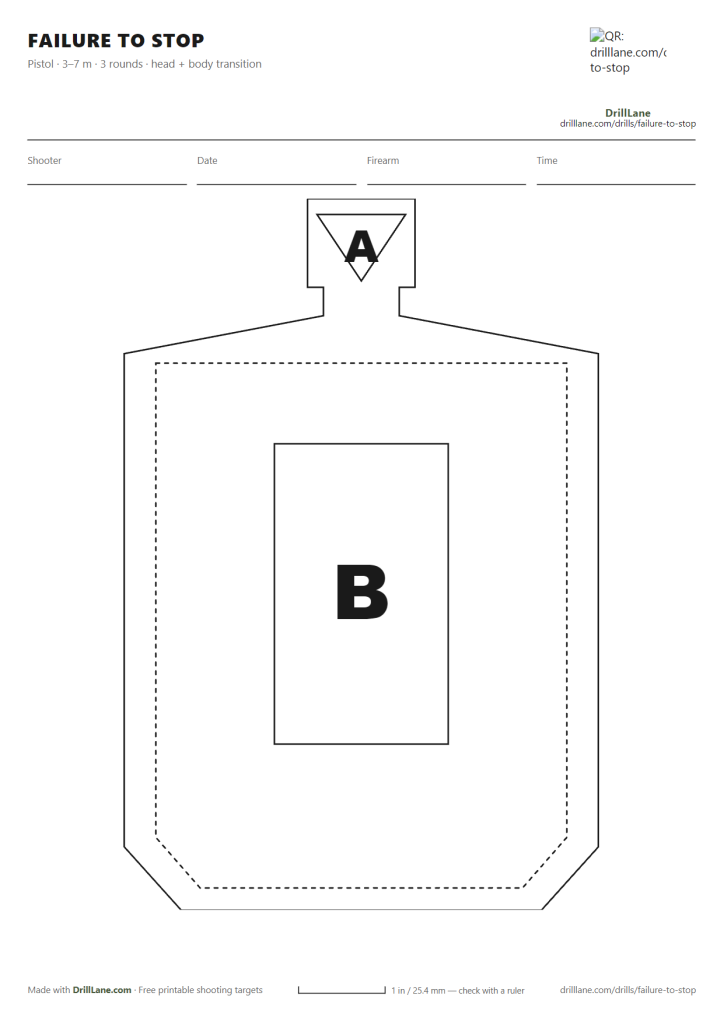


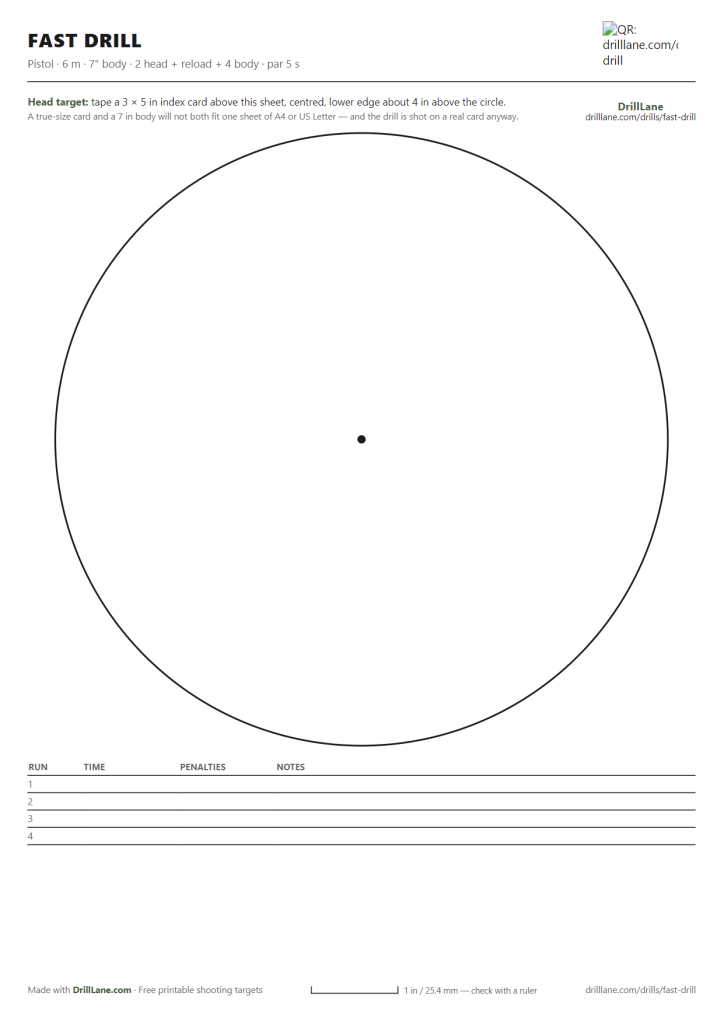
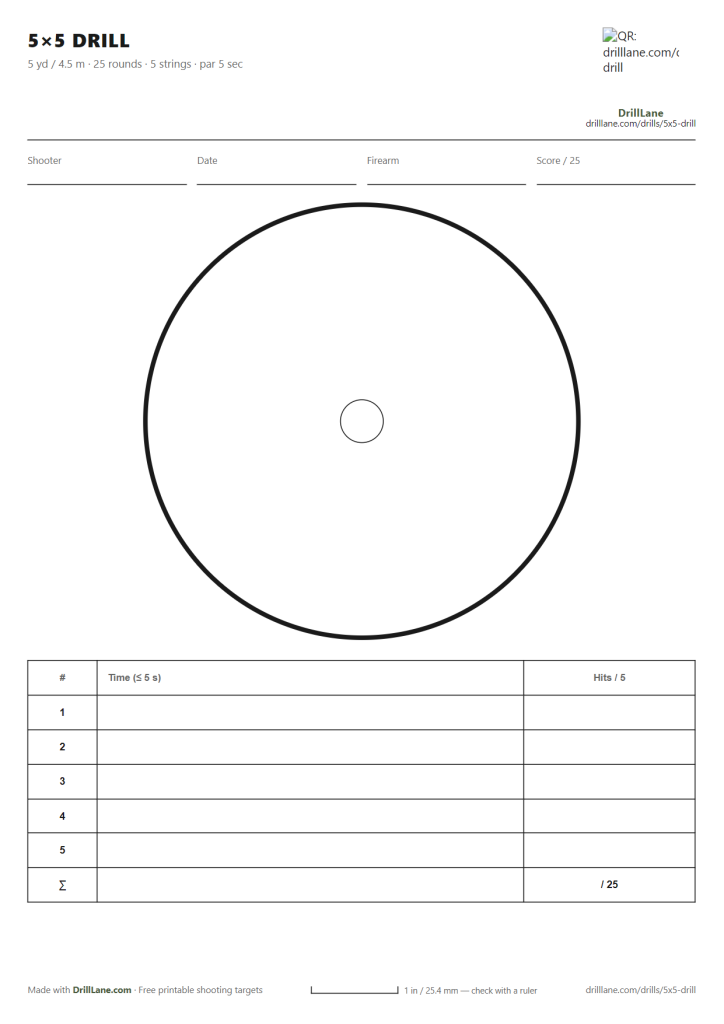


This is the Target Shed. Printable targets, each drawn to true scale and free to download. Every target ships as two PDFs, US Letter and A4, with a 1-inch calibration mark in the footer and a QR code that opens that drill's course of fire, par time, and scoring on your phone.
One reason to use these instead of the next result down the page: we measured them. Most printable-target sites say nothing about print accuracy. The few that mention it hand you an instruction and never publish a number. Our PDF geometry was measured programmatically, ring by ring, and the figures are on this page. A ring that reads 8 inches on the sheet is 8 inches.
How to Print Targets to Scale
Scale is the one variable in printable targets that fails without telling you. A target printed at 92 percent still looks correct. The rings are round, the proportions hold, the sheet fills the page. Nothing on it says the 8-inch ring is now 7.3 inches. You shoot the drill, count hits, write down a score, and that score describes a target which does not exist. Everything built on the number inherits the error: your hit percentage at distance, your par time comparisons, the decision about whether last month's group was progress or noise. Scale errors do not add noise to your data. They add bias, in one direction, every session, and nothing in the results ever looks broken.
Print at actual size and nothing else. In Adobe Acrobat, open Page Sizing and Handling and choose "Actual size" instead of "Fit" or "Shrink oversized pages". In Chrome's built-in PDF viewer, open More settings, set Scale to "Default", and confirm "Fit to page" is off, since some versions shrink to the printable area by default. In macOS Preview, open the print dialog and set "Scale: 100%", not "Scale to Fit". Then match paper to file: the Letter PDF goes on Letter, the A4 PDF goes on A4. Do not print the Letter file on A4 and let the driver sort it out, which is the same mistake wearing a different hat. Print quality is irrelevant here, because resolution does not change geometry.
Verify once per printer, then trust it. Every sheet carries a 1-inch calibration mark in the footer. Put a ruler on it. One inch means the whole page is at scale, because the mark is drawn in the same coordinate space as the scoring rings, so if the mark is right the rings are right. A short reading means the page was scaled down, and the ratio tells you how far off: 0.92 inches is roughly 92 percent, which puts an 8-inch ring near 7.4 inches. Do not compensate by shooting closer or by adjusting scores. Fix the print dialog and print again. Re-check after a driver update, after switching printers, and any time a page suddenly fits the paper differently than it used to.
An engineering note on how we check this. Each PDF is parsed with PyMuPDF and the drawn geometry is measured in PDF points, then converted to inches, so the check runs against the file itself rather than a printed sample. On the B-8 Bullseye, the black aiming area measures 5.54 inches and the outer scoring ring 8.00 inches, and both figures are identical in the A4 and Letter files. That is the reason for shipping two PDFs instead of one: each format is drawn natively at 1:1 rather than squeezed onto the other paper size. The method earned its keep. It caught a real defect, our US Letter files had been rendering at 91.54 percent of true size. Measurement found it, not the eye. We corrected the renderer and re-measured every sheet afterward.
About These Targets
Drill-Specific Targets
Reach for one of these when the drill defines the scoring. A drill-specific sheet carries the exact layout its course of fire is scored on, so hit values, zone edges and dot spacing match the published standard rather than approximating it. Use one whenever you want a score comparable to other shooters, or to yourself six months ago. The Type column in the table above says which sheets these are.
Universal Practice Targets
Use these for volume work with no scoring ceremony: fundamentals up close, slow fire for trigger control, group work at whatever distance the bay allows. One sheet serves several drills, so print a stack and run different work on each without hunting for a matching layout every time you change exercise.
Diagnostic Targets
Print one of these when something is wrong and you cannot name it. A diagnostic sheet isolates one fault at a time — trigger jerk, grip pressure shifting mid-string, anticipation — by shrinking the scoring area until only clean mechanics score. Shoot slow, at one distance, and read the pattern of misses rather than the total.
Fun and Challenge Targets
Bring one of these when the session needs a scoreboard. Challenge sheets keep skill work honest without the weight of a formal standard: a clean run to chase, or a number to beat, easy to shoot head to head with whoever is on the next lane. Useful at the end of a session, when attention is gone but the round count is not.
Target Specs
Every target at a glance, with the type, distance, round count, and formats it ships in.
| Target | Type | Distance | Rounds | Formats |
|---|---|---|---|---|
| Dot Torture | Diagnostic | 3 yd | 50 | A4 / US Letter |
| 50 Yard Zero Target | Diagnostic | 50 yd | 5 | A4 / US Letter |
| B-8 BULLSEYE | Universal | 7 yd | 1 | A4 / US Letter |
| Bill Drill | Drill-specific | 7 yd | 6 | A4 / US Letter |
| Practical Silhouette Target (30% Scale) | Universal | — | 10 | A4 / US Letter |
| 100 Yard Zero Target | Diagnostic | 100 yd | 15 | A4 / US Letter |
| Failure to Stop | Drill-specific | 7 yd | 3 | A4 / US Letter |
| Sight-In Target (1 cm Grid) | Diagnostic | — | 15 | A4 / US Letter |
| 200 Yard Zero Target | Diagnostic | 200 yd | 10 | A4 / US Letter |
| FAST Drill | Drill-specific | 7 yd | 6 | A4 / US Letter |
| 5×5 | Drill-specific | 5 yd | 25 | A4 / US Letter |
| Sight-In Target (1/4 in Grid) | Diagnostic | — | 5 | A4 / US Letter |
| Dot Torture Lite | Diagnostic | 3 yd | 20 | A4 / US Letter |
| Practical Silhouette Target (1/4 Scale) | Universal | — | 10 | A4 / US Letter |
| 36 Yard Zero Target | Diagnostic | 36 yd | 15 | A4 / US Letter |
| 1 Inch Bullseye Target (20 Up) | Universal | — | 20 | A4 / US Letter |
| 1 Inch Dot Target (30 Up) | Universal | — | 30 | A4 / US Letter |
| 2 Inch Bullseye Target (9 Up) | Universal | — | 45 | A4 / US Letter |
| Printer Calibration Test Sheet | Utility | — | — | A4 / US Letter |
| Sight-In Target (1 in Grid) | Diagnostic | — | 5 | A4 / US Letter |
| 10 Meter Air Rifle Target | Universal | 10 m / 11 yd | 9 | A4 / US Letter |
| MOA Grid Target @ 100 yd | Diagnostic | 100 yd | 5 | A4 / US Letter |
| Practical Silhouette Target (1/6 Scale, 2 Up) | Universal | — | 20 | A4 / US Letter |
| 10 Meter Air Pistol Target | Universal | 10 m / 11 yd | 10 | A4 / US Letter |
| 3 Inch Bullseye Target (4 Up) | Universal | — | 20 | A4 / US Letter |
| 25 Yard Zero Target | Diagnostic | 25 yd | 15 | A4 / US Letter |
| 6 Inch Bullseye Target | Universal | — | 10 | A4 / US Letter |
| Mil Grid Target @ 100 yd | Diagnostic | 100 yd | 5 | A4 / US Letter |
| Playing Card Target (4 Up) | Fun / Challenge | — | 20 | A4 / US Letter |
| 3/4 Inch Dot Target (40 Up) | Universal | — | 40 | A4 / US Letter |
| 3×5 Index Card Target | Universal | — | 10 | A4 / US Letter |
| Sight-In Target (1/2 in Grid) | Diagnostic | — | 15 | A4 / US Letter |
| 1/2 Inch Dot Target (54 Up) | Universal | — | 54 | A4 / US Letter |
FAQ
Are these targets really free?
Yes. Every target downloads free, with no account and no email address, and the target face carries no watermark. You get both the US Letter and the A4 PDF for every one of them. There is no print limit and nothing is held back behind a signup form. The sheet you download is the finished sheet, at full scale, ready for the printer.
How do I print shooting targets at the correct scale?
Set the print dialog to actual size and turn off every fit-to-page option. In Adobe Acrobat choose "Actual size" under Page Sizing and Handling. In Chrome's PDF viewer set Scale to "Default" and confirm "Fit to page" is off. In macOS Preview set "Scale: 100%". Then match paper to file, Letter PDF on Letter and A4 PDF on A4, and measure the 1-inch footer mark before you shoot anything.
What is the difference between the A4 and Letter files?
Both are drawn at true 1:1 scale for their own paper size, so the difference is the page, not the target. An 8-inch scoring ring measures 8 inches on the Letter sheet and 8 inches on the A4 sheet. Letter is 8.5 by 11 inches, standard in the US. A4 is 210 by 297 mm, standard nearly everywhere else. Neither file is a conversion of the other, so there is no penalty for shooting the A4 version alongside somebody running Letter.
Which target do I use for which drill?
Match the drill to its own sheet whenever one exists — the Type column in the table above shows which sheets are tied to a specific course of fire. For everything else, reach for a universal sheet. The table also lists distance and round count for each target, and every drill page names the targets it needs.
Can I print these on smaller paper or at reduced scale?
You can, but the score stops meaning anything. Scoring zones are sized for a stated distance, so shrinking the sheet silently changes the difficulty of every hit. If smaller paper is all you have, treat the session as untimed practice and keep the result out of your log next to full-scale scores. Better fix: print at 100 percent on the correct paper, and move the target instead of resizing it.
Why two separate PDFs instead of one file?
Because one file cannot be true scale on two paper sizes. Fitting a single drawing onto the other page forces the viewer or the printer to scale it, which is the exact error we are trying to remove. So each target is drawn natively twice, once for Letter and once for A4, and the geometry is measured in both. Two downloads, no scaling step, identical ring dimensions.
Can I use these for competition practice?
Yes, for practice and for scoring at home. Drill-specific sheets carry the published scoring layout of their course of fire, so times and hit values transfer to the way the drill is scored anywhere else. They are practice targets, not match targets, and we make no claim of certification or compliance with any governing body's specification. At a registered match, shoot whatever the match director supplies.
Do I need a special printer or paper?
No. Any office inkjet or laser printer and plain copier paper will do. Geometry comes from the PDF, not from the printer, so a cheap machine at draft quality prints the same size rings as an expensive one. Heavier stock, 24 lb or more, tears less around the staples and holds up better in wind, and that is the only upgrade worth paying for. Cardboard behind the sheet matters more than the paper itself.
How do I know the scale is right?
Measure the 1-inch calibration mark in the footer with a ruler. If it reads one inch, the rings on that page are correct, because the mark and the scoring geometry are drawn in the same coordinate space. A short reading hands you the scale factor directly: 0.92 inches means about 92 percent. On our side, the geometry of every sheet is measured programmatically with PyMuPDF before release, but that check cannot see your print dialog. That part is the ruler's job.
Can I share or reprint these targets?
Yes. Print as many copies as you want, and hand them to a training partner, a class, or a club. The QR code on the sheet takes anyone to the drill's instructions, so a target passed across the bay still explains itself. If you are putting them on a website or into a handout, link back to this page rather than rehosting the PDF files. Rehosted copies go stale, and a shooter working from an old file has no way of knowing a sheet was re-measured since.